
You Didn’t Plan to Write a Book. That Doesn’t Mean You Shouldn’t.
I hesitate to make generalizations, but I’ve thought long and hard about this one:
There are two ways into writing a book.
1. Some people start with the ambition and go hunting for the idea. They know they want to write a book, so they ask: what should it be about? They strategize, they decide, they begin. The form comes first. The content follows.
2. Then there are people — I’ll go out on a limb and say, people like you. The idea came first, and the book wasn’t even on your radar. You were out there in these streets doing your work, serving clients, building something, solving problems no one else has thought to solve quite the way you have, and suddenly a thought surfaced. This could be a book. You didn’t plan it. You didn’t ask for it. It just showed up.
If that’s you, you’re an idea-first author. And I think most authorpreneurs are.
I certainly am. I spent years imagining I might write a book about John Locke’s philosophical awakening and return to his early natural law theory. That felt like the kind of book I was supposed to write. Even after I started my business, writing a business book never crossed my mind. A book about how to write a business book crossed my mind even less. That idea found me. I didn’t find it.
In fact, I think it works this way more often than the other way.
Maybe your experience looks something like this: someone told you that you should write a book and it lodged in your brain. Or a friend did it and you thought, I could do that.
Maybe you’re a speaker and you keep seeing other speakers on stage talking about their books.
Maybe you have a PhD, or 20 years of hard-won expertise, and somewhere in the back of your mind you’ve always known there was a book in there.
Whatever the path, the idea arrived uninvited. And now it won’t leave, which you’re happy about (99% of the time).
Welcome. You’re in the right place. The rest of this post is for you.
The Ghosts That Come With It
Being an idea-first author comes with some other uninvited guests, who you might not be so happy to see.
There’s the overwhelm. The sheer scale of what it seems like it would take to actually write and publish a book is duanting. You’ve seen what goes into it. The time alone feels impossible when you’re running a business.
There’s imposter syndrome. You look at the authors whose books line your shelves and wonder who you are to stand alongside them. They seem so certain of their authority. You feel like you’re still working things out.
And underneath both of those is something subtler: a nagging suspicion that you’re not quite ready (Oh. Hello Maude! 👋🏼). There’s a deep feeling that you’d need to become something you’re not yet — a “real” writer, a more established expert, someone with more credentials or more clarity — before you could legitimately do this.
These ghosts all point to the same fear, really. That something is missing. That you’re lacking what it takes. That the idea showed up at the wrong address.
I want to challenge that fear directly.
The Philosophy: The Idea Chose You for a Reason
Socrates, ancient Greek teacher of Plato, sometimes described his work as midwifery. He wasn’t teaching people things they didn’t know. He was helping them give birth to knowledge already inside them. His premise was radical: wisdom isn’t something you acquire from the outside. It’s something you uncover from within.
I think about this when I work with idea-first authors, because it names exactly what I see. The people who come to me aren’t lacking anything. They’re not missing the idea, the expertise, or the authority. What they’re missing is someone to ask them the right questions to help them surface what’s already gestating.
Here’s what I believe: the idea wouldn’t have shown up if you weren’t ready for it.
This belief doesn’t belong to me alone. Elizabeth Gilbert talks about ideas as active, not passive. They circulate, looking for the right person, the right moment, the right conditions. When one lands with you — when it sticks, when it keeps coming back, when it nags at you in the in-between moments — that’s not random. That’s the idea choosing you.
Sure, in one sense, you’re not yet an author because you haven’t finished your book. But you’re an expert and an author is just an expert who has written a book. The book is not a monument you erect once you’ve fully arrived. It’s a conversation you’re already having with clients, with audiences, with anyone who’s ever heard you talk about your work and leaned in. The book just lets you have that conversation at scale, with people you haven’t met yet.
The wisdom is inside you. It’s been there for a while now. Your job isn’t to acquire it. It’s to trust yourself (and your reader) enough to let it out.
The Practice: Try the Idea On Before You Commit
None of this means you need to sit down Monday morning and start writing. Premature commitment is its own trap. It creates pressure that triggers resistance, and suddenly the thing that excited you feels like an obligation you can’t fulfill.
What I’d encourage instead is something simpler. Try the idea on. Let yourself imagine, without any stakes, what it would look like to write this book. Forget about the how for now. Just think about what it would feel like to be someone who wrote it.
And in the meantime, pay attention. Notice which ideas people respond to when you talk about your work. Notice what questions clients keep asking you that you keep having to answer from scratch. Notice what you find yourself explaining over and over, the thing that seems obvious to you but keeps surprising people. That’s the book. It’s already happening.
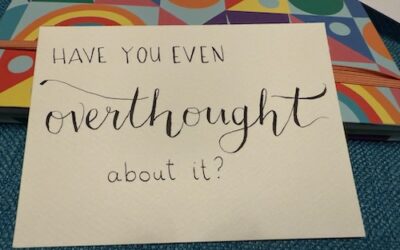
You don’t need to force a decision. But you also don’t want to let the overthinking spiral, sending you into permanent indecision. Give yourself a defined window to sit with the idea — think: a few weeks, not a few years. Use that time not to plan the book, but to get honest about whether you want to write it. Here are some questions to help you think it through:
On the idea itself:
- What is the one conversation this book would start?
- What do you know about your work that most people in your field are getting wrong, or missing entirely?
- If a client read this book before working with you, what would you want them to understand that they currently don’t?
On your readiness:
- What is the idea you’ve been carrying around longest — the one that keeps surfacing no matter how many times you push it down?
- What do people respond to most when you talk about your work? What makes them say you should write a book about that?
- If you weren’t afraid of being judged, what would you most want to say?
On the fit:
- Is a book actually the right container for this idea, or is it a course, a talk, a body of articles?
- What would it mean for your business to have this book exist in the world?
- What would you regret more in five years — having written it, or not having written it?
These aren’t questions to answer all at once. They’re questions to sit with, return to, let percolate. It’s the work that needs to happen before the writing begins, and it matters.
The idea-first author’s problem is never really a lack of ideas or expertise. It’s a crisis of permission. You’re waiting for something (some imaginary committee, some credential, some sign, some external validation) that will tell you you’re ready.
Here’s the thing: that sign isn’t coming. But the idea already did. And if you ask me, that’s permission enough.
If the questions above stirred something but you’re still not sure whether a book is actually your next move, that’s exactly what my live workshop on March 18th is designed to help you figure out. Should I Even Write This Book? is 90 minutes to get you from “I keep thinking about this” to a decision you can feel good about. $47 — join us here.
Image by Freepik.com