Your Keynote and Your Book Should Be the Same Idea
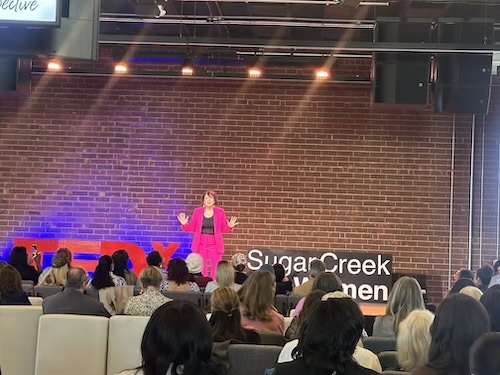
I spent this past Saturday at a TEDx event, cheering on my friend (and fellow NSA Carolinas member) Susie Hansley, as she took the stage. She did an amazing job! I heard some great talks and met some cool people. But the value didn’t stop when the event did. Truth be told, I haven’t been able to stop thinking about what I observed.
See, sitting in a TEDx audience makes my brain buzzy. I feel inspired, of course (who doesn’t?). But I also get a little analytical. 🧐 I start thinking about the architecture of each talk. What’s the Big Idea? How did the speaker find the through-line? How did they distill everything they know into 9 minutes?
The event also happened to fall after I’d just finished writing a TEDx talk for a new client — a NOLA attorney who has spent his career going after insurance companies that refuse to pay claims after natural disasters. (Yes, he’s as fierce as he sounds, and yes, his talk is going to be fire. 🔥🔥🔥)
So there I was, sitting in that audience with all of this swirling around in my brain.
And then it hit me, again. There’s a question I get asked often, and I never see it addressed directly. So let’s address it.
“Should my keynote and my book be about the same thing?”
Yes. A thousand times yes.
I know that sounds almost too simple, like, of course they should be related. But you’d be surprised how many people — smart, accomplished, Big Idea folks — treat their keynote and their book as completely separate projects that happen to be associated with the same person.
They’re not. Or at least, they shouldn’t be.
I can understand the worry. You don’t want to be pegged as a “one trick poney” or boring. And you don’t want to “give away” your book idea during a talk.
Here’s how I think about it, though: your book and your keynote (or your signature talk, or your TEDx — I use these terms pretty interchangeably) are two different containers for the same Big Idea.
One is 18 minutes (or 10 minutes or 90 minutes).
One is 40,000 words.
One you deliver standing up in front of an audience.
One lives on a shelf, or in a Kindle, or on a nightstand.
But the idea at the center is the same. Both your book and your talk should do two things:
- They should make it clear what ONE thing you want your audience to walk away knowing.
- They should be about the ONE question you want to own the answer to.
If they’re not pointing at the same thing, you’ve got a problem — not because the ideas are bad, but because you’re splitting your attention (and your audience’s attention) between two different messages. And that makes it harder to be known for anything.
They feed each other.
Here’s what I love about having both a keynote and a book when they’re rooted in the same Big Idea: they make each other better.
Your talk is a testing ground. Before your book is finished (ideally while you’re writing it), you should be standing in front of audiences and saying the thing out loud, watching people’s faces, noticing which stories land and which fall flat, and finding out which part of your argument makes people’s eyes light up and which part makes them look confused. A live audience will give you feedback that no editor can.
Your book, on the other hand, gives your talk its spine. It signals that you’ve done the deep work. It’s the artifact people can take home, share, and return to. When someone hears you speak and they want more, the book is the “more.”
This is what I mean when I talk about building a Thought Leadership Ecosystem. Your book isn’t a standalone document, and your TEDx isn’t just a way to get tons of eyeballs on your thoughts. They’re two stars in a larger constellation that, when aligned, become a visibility engine.
What to do if you have one but not the other
If you have a talk but no book: Your talk is already an outline waiting to be expanded. The structure is there. The Big Idea is there. The stories are there. You’ve been beta-testing your content every time you’ve delivered it. Now it’s time to go deeper — to give each section of your talk room to breathe, to add the nuance you never have time for on stage, to write the book that makes people say “I need to hear this person speak.”
If you have a book but no talk: Start by asking yourself, “if I had to distill this entire book into one sentence — the ONE thing I want my reader to walk away with — what would it be?” That’s your talk. The single most important idea, delivered with your whole body, in real time, to people who need to hear it.
If you’re not sure how to do that, I can help. Writing keynote speeches is actually something I do, though I’ll be the first to admit I don’t talk about it nearly enough. (Sitting in that TEDx audience this weekend reminded me why I should.) If you have a book and you’re ready to take your idea to the stage — or if you have a talk and you’re ready to turn it into a book — let’s talk.
Your Big Idea is bigger than any single format. The most effective thought leaders I know aren’t choosing between a book and a keynote. They’re using both, and they’re using them together, because they understand that the more ways your idea shows up in the world, the more likely it is to find the people who need it.
Same idea. Different containers. Maximum reach.
Want more on building your Thought Leadership Ecosystem — and turning your Big Idea into something the world can actually find? Subscribe to my newsletter here.
Image designed and captured by Emily Crookston.